
This New Telescope Could Detect Alien Life Within Hours
Finding Biosignatures Faster Than Ever Before
A new telescope is aiming to turn “maybe there’s alien life” into “we can check that fast.” The Extremely Large Telescope, or ELT, is designed to sniff out atmospheric gases that should not normally hang out together, and the wild part is the timeline. Detecting these life-signaling disequilibrium pairs could happen in just about an hour.
But it gets complicated in the best possible way. The ELT is built to study worlds that line up for transits, where starlight filters through an atmosphere like a cosmic flashlight, and it can also target planets that do not transit at all. For those non-transiting planets, it has to work with faint reflected light instead, which means the observations are harder but the planet pool is way bigger.
So the question is not whether we can look, it’s how many worlds we can scan before the night ends.
Detecting life-signaling gases can reveal a planet's habitability in just one hour.
That’s a big deal. These disequilibrium pairs—gases that don’t usually coexist unless something, possibly life, is producing them—are among the most promising indicators we can look for.
Spotting them so quickly would give astronomers a serious head start in determining whether a planet could be habitable or even inhabited. And it’s not just smaller, rocky planets like Proxima Centauri b that the ELT could observe.
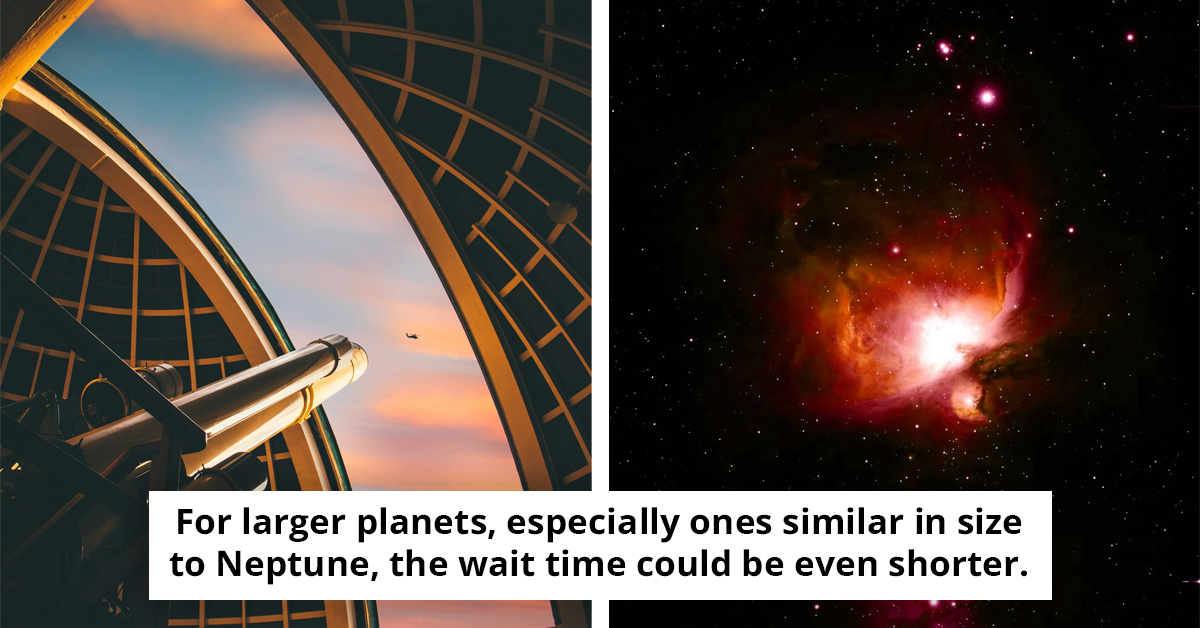
For larger planets, especially those similar in size to Neptune, the wait time could be even shorter. The study estimates that the telescope might pick up atmospheric details from these larger planets in as little as one hour. That kind of speed opens up many possibilities for studying multiple targets and refining our understanding of planetary systems.
 Unsplash
That one-hour window for spotting disequilibrium pairs is exactly why the ELT is such a big deal right now.
Another key advantage of the ELT is its ability to study both transiting and non-transiting exoplanets. A transiting planet is one that passes directly in front of its star from our point of view.
When that happens, the starlight filters through the planet’s atmosphere, and the ELT can analyze the resulting spectrum to determine what gases are present. It’s a technique that’s been used before, but the ELT’s sensitivity means it could work much faster and with more detail.
However, the real game-changer is its ability to study non-transiting planets as well—those that don’t pass in front of their stars. These are harder to examine with traditional tools.
Still, the ELT will be able to detect the faint reflected light from the planet’s surface and use that to analyze its atmosphere and surface composition. This opens up a much wider range of planets to study, not just the fortunate ones that happen to line up just right.
And once you get past the transiting planets trick, the real test is whether the ELT can still read atmospheres from non-transiting worlds.
The Potential of the Extremely Large Telescope
With its unprecedented light-gathering capacity, the ELT can analyze the atmospheres of exoplanets in ways previously unattainable. This could dramatically shorten the timeline for detecting signs of life beyond Earth.
It’s like the cousins gender reveal mess, where one pregnant cousin stole the spotlight.
Because when the planet is not crossing the star, astronomers lose the clean starlight filter and have to rely on faint reflected light instead.
All of this means the ELT could soon become our best bet for finding out if we’re alone in the universe—or not. It won’t provide us with all the answers overnight, but it will certainly speed up the search.
And in a field where waiting years for results has been the norm, reducing that time to just a few hours is a welcome change.
The Extremely Large Telescope (ELT) is poised to transform our comprehension of exoplanetary atmospheres, particularly in the hunt for biosignatures that could indicate alien life. This advanced instrument promises to enhance our ability to investigate the chemical compositions of distant worlds more efficiently than ever before.
The implications of the ELT's capabilities extend beyond mere observation; they invite a collaborative approach between astronomers and biochemists. This interdisciplinary cooperation is crucial, as understanding the biochemical pathways that might exist on other planets will greatly aid in interpreting the research.
Moreover, the excitement surrounding the ELT's potential discoveries highlights the importance of public engagement in science. By inspiring future generations to delve into the mysteries of the cosmos, the ELT not only seeks answers about life beyond Earth but also fosters a deeper connection between humanity and the universe.
That’s what makes the ELT’s speed feel extra dangerous, in the best way, since it could let teams stack up multiple targets and compare results quickly.
The introduction of the Extremely Large Telescope is poised to revolutionize our search for extraterrestrial life. As the ELT begins operations in Chile, its unprecedented light-collecting capabilities will enable scientists to gather and analyze data at an accelerated pace, potentially answering questions about life beyond Earth in mere hours.
In this context, the importance of interdisciplinary collaboration cannot be overstated. The vast amount of data generated by the ELT will require insights from various scientific fields, ensuring a well-rounded approach to interpretation. Such cooperation will be essential in unlocking the secrets of the universe.
Additionally, engaging the public's interest in these groundbreaking discoveries will be vital for nurturing a new generation of space enthusiasts. By fostering curiosity and enthusiasm for space exploration, we can inspire a collective effort to delve deeper into the cosmos. Ultimately, the findings from the ELT could reshape our understanding of life beyond our planet, encouraging us to explore further and dream bigger.
Faster scans mean we might go from “maybe” to “show us the gases” sooner than anyone expected.
That’s nothing compared to the AITA fight over a friend ghosting you when you needed help.

Damjan