Elon Musk Sparks Debate With Neuralink Hearing Implant Idea
Neuralink’s promise to restore hearing sparks skepticism and calls for inclusion.
Elon Musk’s Neuralink hearing implant idea kicked off the kind of online debate that refuses to stay polite. One tweet turned into a whole argument about what “restoring” hearing even means, and who gets to decide.
Here’s the complicated part: devices that help hearing already exist, like cochlear implants that sit in the cochlea and route sound signals through the cochlear nerve. Meanwhile, deaf adults are pushing back hard on the idea of a brain chip, pointing to autonomy, and to the fact that many deaf people have a history of being subjected to unwanted treatments “for their own good.”
And when @DeafLibertarian told Musk to meet with deaf adults before moving forward, the conversation shifted from science talk to lived experience, fast.
Musk’s tweet
While Musk’s comments excited some, many pointed out that devices designed to restore some hearing already exist. Cochlear implants, for example, don’t go into the brain but are placed in the cochlea, the spiral-shaped part of the inner ear.
These devices use small magnets and electrodes to bypass damaged parts of the ear and send signals directly to the cochlear nerve, which then carries the sound information to the brain.
Musk’s tweet lit the fuse, but the replies quickly jumped from “cool tech” to “who asked for this?”
Moreover, the psychological concept of autonomy is crucial here. Autonomy, the right to self-governance, is a fundamental element of ethical healthcare decisions (Manson, 2017). If an individual is comfortable with their deafness and identifies with the Deaf community, it is essential to respect their autonomy in deciding whether they want their hearing 'restored'.
Many deaf adults want early input on Musk’s brain chip plans, citing past forced treatments as the reason for their caution.
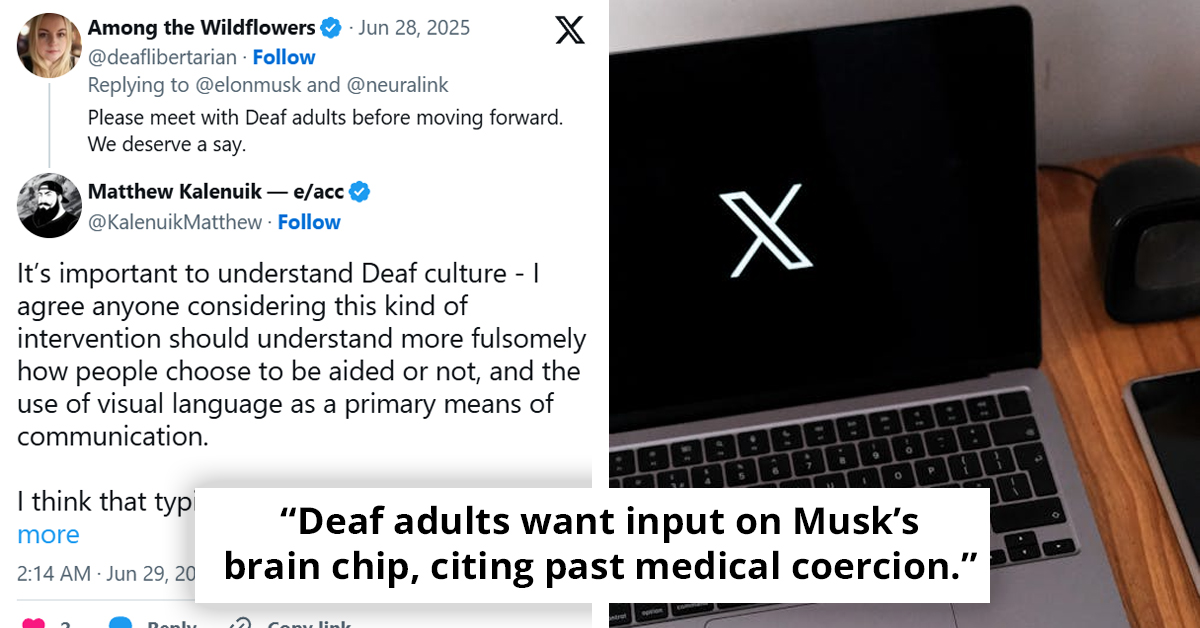
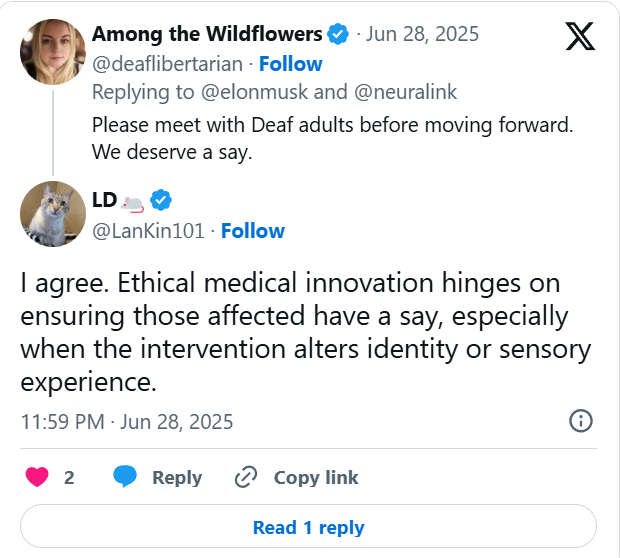
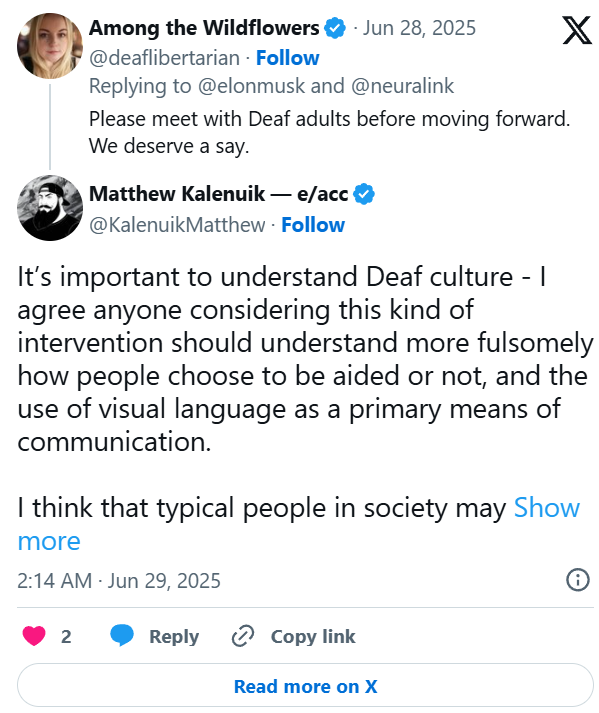
But the idea of using a brain chip to “restore” hearing isn’t sitting well with many deaf adults. One social media user, who posts as @DeafLibertarian, responded directly to Musk’s tweet, writing, “Meet with Deaf adults before moving forward. We deserve a say.”
She went on to explain that deaf people need to be involved in the research process from the beginning. “Involving us in the research process, especially in the early stages, ensures decisions truly consider all aspects of lived experiences for people born deaf,” she wrote.
Another important point she raised is that skepticism from deaf people doesn’t mean they reject technology altogether. “Most deaf people are not against new technology or medical enhancements,” she added.
But she emphasized that deaf people are a vulnerable group because of a long history of being subjected to unwanted medical procedures in the name of “helping” them.
“They have been forced against their will for many things in the name of science, ethics, or research,” she tweeted. “So give them (and me) some grace if we are skeptical and question the intent of any company that says they want to help.”
 X
X
Some users warned that trying to “fix” deafness without understanding deaf culture can alienate the community.
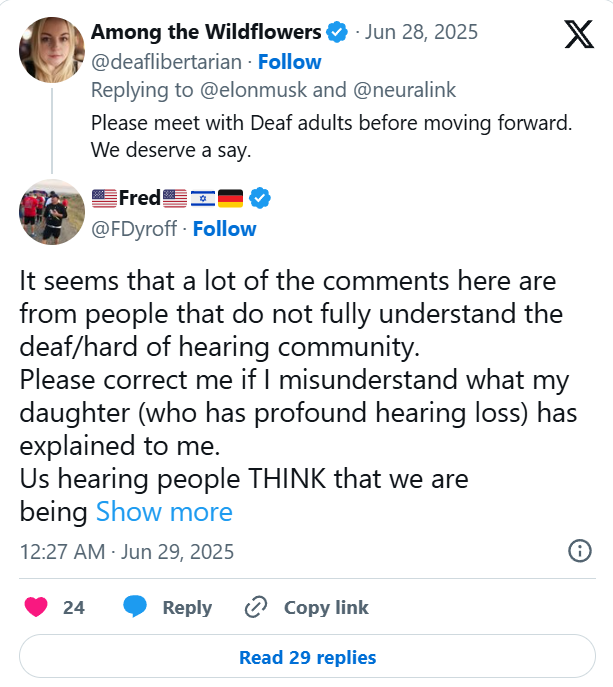
Other social media users chimed in with similar concerns. One parent shared that his daughter, who has profound hearing loss, sees technologies like Neuralink’s as an effort to “fix” her, rather than accept her as she is.
He suggested that more conversations with people who are deaf would help tech companies better understand the community’s needs and concerns. Some replies pointed out that many scientists and entrepreneurs see deafness purely as a “problem” to solve, overlooking deaf culture, identity, and the community that many deaf people value.
This perspective can turn well-intentioned inventions into something alienating or even threatening.
 X
X
People brought up cochlear implants, and the discussion got even sharper once the bypassing of damaged parts was compared to a brain-level approach.
It also reminds us of the office worker stuck deciding whether to mention a coworker’s constant burping.
Neuralink has been getting attention for other breakthroughs, too. The company shared a video showing a monkey seemingly “telepathically” asking for snacks, and recently, the first human Neuralink recipient, Noland Arbaugh, who is paralyzed, posted on Twitter just by thinking.
In a post following Arbaugh’s update, Musk said: “Long-term, it is possible to shunt the signals from the brain motor cortex past the damaged part of the spine to enable people to walk again and use their arms normally.” While this technology offers hope to many, it also shows how complex and powerful Neuralink’s implants could become.
Neuralink showed mind-controlled tweeting and hinted at restoring movement in the future.
 X
X
Then @DeafLibertarian pushed the real sticking point, “meet with Deaf adults,” because deaf people want to be involved from the start, not after decisions are made.
The discussion surrounding Neuralink's proposal to use brain implants for restoring hearing underscores the intricate layers of deafness that extend beyond a mere physical condition. Deafness is interwoven with cultural identity and psychological experience. Many individuals in the deaf community perceive their identity as intricately linked to their culture and language, often seeing themselves as members of a dynamic linguistic community rather than as disabled individuals. This perspective reveals the critical need to examine the psychological and social ramifications associated with the idea of 'fixing' deafness, raising questions about who truly benefits from such technological advancements and at what cost to cultural identity.
The thread ended up circling back to autonomy, with deaf skepticism framed as a response to past forced procedures, not a rejection of technology.
For deaf adults, it’s about having a voice in decisions that could affect their lives, identities, and rights.
Technology has the power to change the world, but if it doesn’t include the people it’s meant to help, it risks repeating old mistakes and creating new ones.
Elon Musk’s proposal for Neuralink to develop a brain implant aimed at restoring hearing raises significant questions about the societal implications of such technology. The excitement surrounding these advancements must be tempered by an awareness of their potential impact on cultural identities, particularly within the Deaf community. The suggestion that technology could enhance lives risks overshadowing the rich cultural heritage that defines Deaf culture. It is essential to navigate these discussions with sensitivity, ensuring that innovations do not inadvertently undermine the values and identity of those they intend to assist. Furthermore, as we explore the capabilities of these new technologies, we must remain vigilant about their effects on our well-being and the core values we hold. A nuanced understanding of deafness and the unique experiences of the Deaf community is crucial to developing solutions that truly respect and uplift rather than erase their cultural significance.
As discussions surrounding Neuralink's proposed hearing implant gain momentum, it is crucial to examine the psychological, social, and cultural implications for the communities affected. The promise of restoring hearing through technology raises questions about accessibility and equity. The intersection of innovation and human experience cannot be overlooked, as it shapes not only individual lives but also community dynamics. The potential for such technology to alter relationships and social interactions is significant, highlighting the need for a thoughtful approach to ethical innovation. It is imperative that as we advance, we do so with an awareness of the diverse needs and values of those impacted by these developments.
Musk might be debating a future hearing chip, but deaf adults are demanding a say in the present.
Still skeptical about “new tech” claims? These 60+ antiques prove good design never ages, see the evidence.

Damjan