
Scientists Stumped by Bizarre Signals Deep Within Antarctica
Signals from the Ice That Shouldn’t Exist
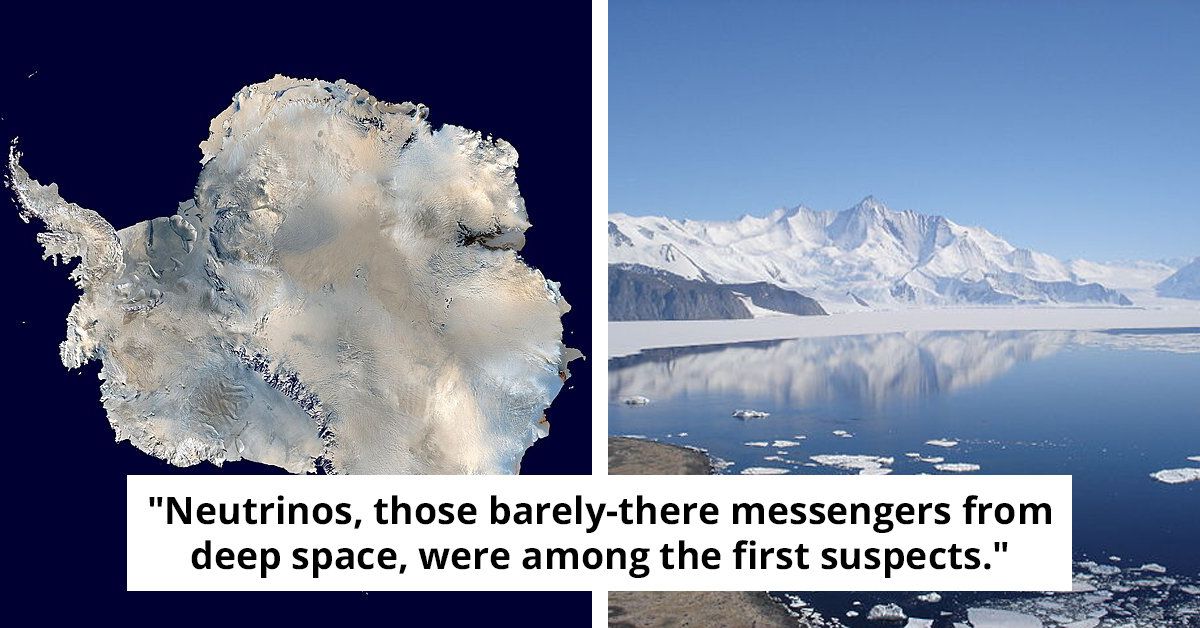
Antarctica is quiet in the way a locked door is quiet, and NASA’s ANITA mission just banged on that silence with signals that do not behave like anything scientists expected. The weird part is not that the data is interesting, it is that the trail to the detector seems like it should have ended before it ever got there.
Physicist Stephanie Wissel, who’s been closely involved in the investigation, says the study adds information, but it does not point to brand-new physics. The complication? Anomalies are showing up in a way that should have been impossible to survive the journey, and they most likely are not neutrinos, even though they are being talked about in that context.
So the question becomes less “Is it new physics?” and more “How did the signal even make it to the ice?”
Physicist Stephanie Wissel says the events add data but don’t suggest new physics.
Stephanie Wissel, an associate professor of physics and astrophysics at Penn State, has been closely involved in the investigation.
“While the origin of these events is still unclear,” she said, “our new study indicates that such events have not been seen by an experiment with a long exposure like the Pierre Auger Observatory. So, it does not indicate that there is new physics, but rather more information to add to the story.”
 commons.wikimedia
ANITA snagged the anomalies from deep over Antarctica, and that is where the whole “how did it survive?” problem starts to rear its head.
In other words, they haven’t found proof of some previously unknown force or particle—not yet, anyway. But these weird signals don’t fit into the usual pattern.
One of the biggest puzzles is how the signal made it to the detector in the first place.” That kind of path should have killed the signal completely, making it impossible to detect. And yet, ANITA caught it.
“It’s an interesting problem because we still don't actually have an explanation for what those anomalies are,” she added, “but what we do know is that they're most likely not representing neutrinos.”
The intriguing anomalies detected by NASA's ANITA project are not just captivating to scientists; they present a significant puzzle that could reshape our understanding of fundamental physics. The signals emerging from the depths of Antarctica have drawn in both astrophysicists and glaciologists, who are keen to unravel this mystery. The unique environmental conditions in Antarctica may play a crucial role in amplifying these signals, making them easier to detect than they would be in more temperate regions.
If these signals are indeed tied to a new source, they hold the potential to revolutionize our grasp of neutrinos, those elusive particles fundamental to the framework of physics. The implications of such a discovery could extend far beyond particle physics, offering new insights into the universe itself and perhaps leading to breakthroughs that challenge our existing paradigms. The scientific community is watching closely as researchers continue to probe these bizarre signals, hoping to unlock the secrets hidden beneath the ice.
Neutrinos were early suspects because they’re nearly undetectable but reveal distant cosmic sources.
Neutrinos were the leading suspects early on. These tiny, neutral particles are all over the universe and pass through nearly everything without leaving a trace.
That’s part of what makes them so hard to study, and also what makes them valuable. If you catch one, it means it traveled huge distances without hitting anything. That can tell scientists a lot about where it came from.
“You have a billion neutrinos passing through your thumbnail at any moment,” Wissel said. “But neutrinos don't really interact. So, this is the double-edged sword problem. If we detect them, it means they have traveled all this way without interacting with anything else. We could be detecting a neutrino coming from the edge of the observable universe.”
 commons.wikimedia
Wissel points out that the Pierre Auger Observatory, using a long exposure, did not see the same kind of events, which makes the mystery even harder to pin down.
This feels like the trip where a parent praised a friend’s well-behaved daughter, then got accused of racism.
The moment you realize the path should have killed the signal completely, the Antarctica setting stops feeling “background” and starts feeling like part of the trick.
But the more researchers compared ANITA’s data with readings from other neutrino detectors, the more they realized it probably wasn’t neutrinos after all. That only deepened the mystery.
“My guess is that some interesting radio propagation effect occurs near ice and also near the horizon that I don't fully understand,” Wissel admitted. “But we certainly explored several of those, and we haven't been able to find any of those yet either. So, right now, it's one of these long-standing mysteries.”
NASA and its partners are developing a new, more advanced version of ANITA to improve detection capabilities. The next balloon experiment, named PUEO, is planned to be larger and more sensitive.
This upgraded instrument aims to provide clearer answers and possibly solve the ongoing mystery. With its enhanced sensitivity, PUEO is expected to detect more unusual signals and potentially reveal their nature.
There is also the possibility of detecting neutrinos, which would mark a significant scientific breakthrough. For now, the Antarctic ice continues to hold its secrets.
And because Wissel says they are most likely not neutrinos, the signals keep forcing scientists to rethink what category they belong in.
Understanding the perplexing signals from beneath Antarctica demands a concerted effort from diverse scientific disciplines. The article highlights the critical need for collaboration between glaciologists and particle physicists to decode these anomalies. By integrating their distinct areas of expertise, researchers can unlock deeper insights into the mysterious phenomena occurring under the ice.
This call for interdisciplinary cooperation is further exemplified by the suggestion for improved data-sharing platforms among research institutions. Such initiatives could not only lead to innovative solutions but also enhance the scientific method itself, providing a more holistic view of these intricate challenges. The quest to unravel the secrets of Antarctica serves as a testament to the necessity of collaborative research in advancing our understanding of the natural world.
The strange signals from deep within Antarctica have sparked intrigue among scientists from multiple fields.
Antarctica kept its secrets, and now the signals are acting like they do not belong to any neat box.
Want more shockingly timed fallout, read about a father demanding his daughter repay $10K after the groom cancels for cheating.

Damjan