Scientists Puzzled by Mysterious Glowing Object Racing Toward Earth
Later this year, 3I/ATLAS is expected to pass very near Mars
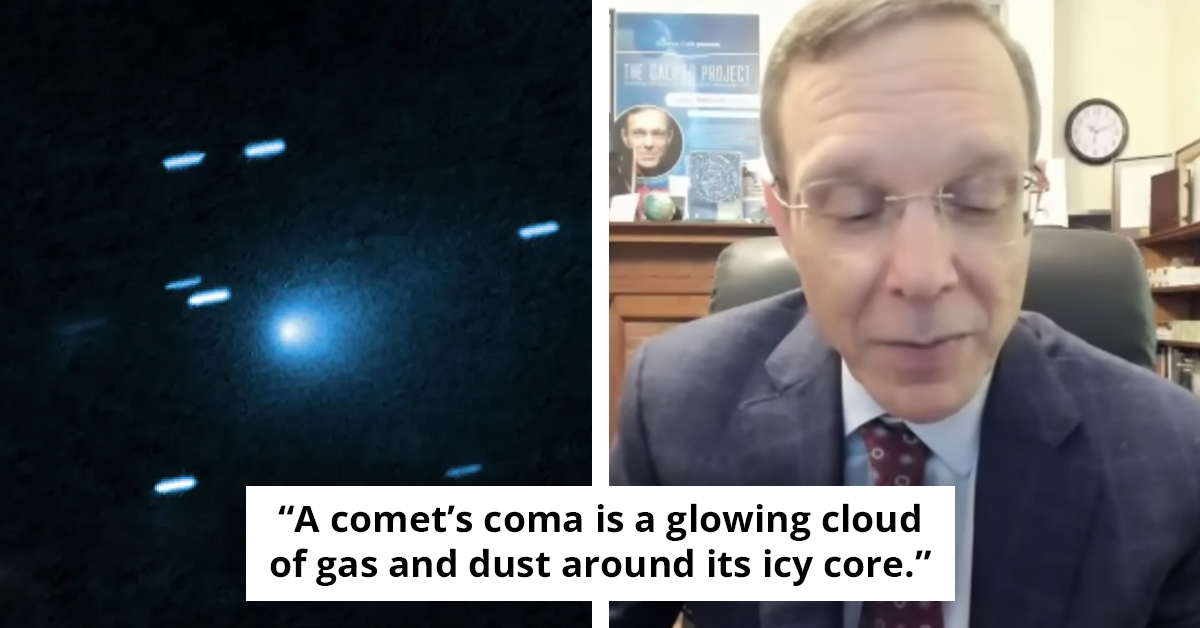
Scientists are watching a tiny visitor sprint toward the inner solar system, and it is glowing like it has its own agenda. The object, 3I/ATLAS, is expected to pass very near Mars later this year, and it is already throwing astronomers off because it does not behave like a normal space rock with a simple reflect-and-fade routine.
What makes this so messy is the brightness profile. After talking with Harvard colleague Eric Keto, Harvard’s Avi Loeb floated an idea that sounds like sci-fi, 3I/ATLAS might be producing its own light, not just bouncing sunlight back to us. He laid out two wild explanations, a rare radioactive fragment from a nearby supernova core, or something even stranger, a spacecraft powered by nuclear energy with dust smeared off its front from years of interstellar travel.
The closer it gets, the harder it is to ignore, because the next pass near Mars could turn a “steep brightness” puzzle into a real answer, or a bigger mystery.
Later this year, 3I/ATLAS is expected to pass very near Mars
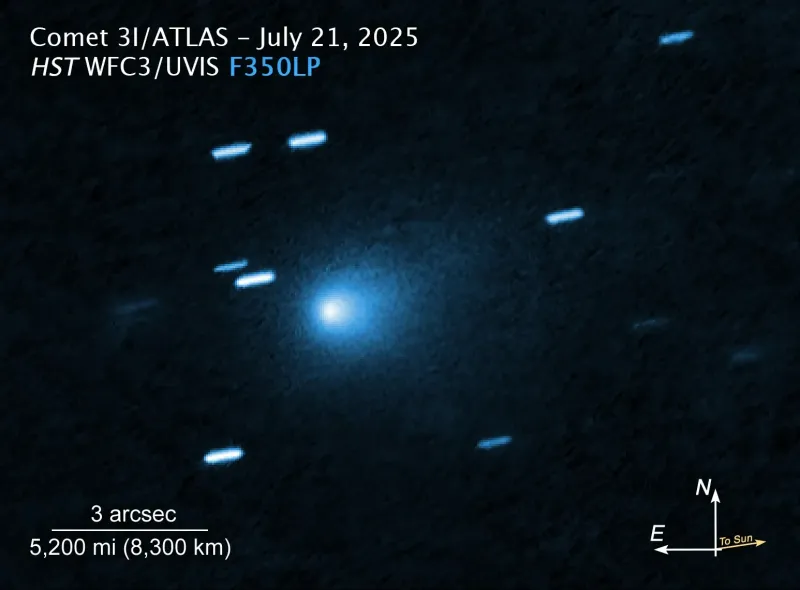 D. Jewitt et al/NASA/Wikimedia
After discussions with Harvard colleague Eric Keto, Loeb has suggested that 3I/ATLAS may be producing its own light rather than simply reflecting sunlight or glowing due to a coma.
Loeb explained that the “simplest interpretation” of its “steep brightness profile” is that the object’s nucleus itself “produces most of the light.”
How could that be possible? Loeb laid out two possibilities. The first is that the object could be a “rare fragment from the core of a nearby supernova that is rich in radioactive material,” which is naturally emitting radiation.
The second, far more provocative idea, is that it might actually be “a spacecraft powered by nuclear energy, and the dust emitted from its frontal surface might be from dirt that accumulated on its surface during its interstellar travel.”
That’s when Loeb’s conversation with Eric Keto starts to matter, because the “steep brightness profile” is what pushes the whole thing beyond simple light-reflection.</p>
The Thrill of the Unknown
The discovery of the 3I/ATLAS object and the mystery surrounding it likely elicits a sense of excitement and curiosity in the general public. This is backed by psychological research indicating that humans are naturally drawn to the unknown. This can be explained by the Information Gap theory, proposed by George Loewenstein, which suggests that a gap in our knowledge creates a kind of cognitive dissonance that we seek to resolve. George Loewenstein’s Information Gap Theory
After discussions with Harvard colleague Eric Keto, Loeb has suggested that 3I/ATLAS may be producing its own light rather than simply reflecting sunlight
Then the supernova-fragment theory gets tossed into the ring, even though Loeb admits it is highly unlikely.</p>
Loeb admitted that the supernova fragment theory is “highly unlikely” and that the spacecraft idea would require stronger evidence before it could be considered “viable.” Still, his willingness to explore these possibilities has once again brought attention to the broader debate about interstellar objects and their origins.
A radical new theory
After that, the nuclear-powered spacecraft idea comes in like a plot twist, with dust from the object’s frontal surface doing the heavy lifting.</p>
Putting 3I/ATLAS in context
If Loeb’s theory is correct, 3I/ATLAS may be much smaller than initial estimates suggested, bringing it closer in size to the only two other known interstellar visitors: ’Oumuamua, discovered in 2017, and 2I/Borisov, observed in 2019. Both of those objects sparked heated debates about what kinds of bodies travel between star systems and what their presence means for us.
A close encounter ahead
Later this year, 3I/ATLAS is expected to pass very near Mars. Scientists believe this flyby could provide the best chance to study the object in greater detail. Loeb has urged astronomers to seize this opportunity to better understand its true nature.
Whether it turns out to be an unusual comet, a radioactive fragment from a long-dead star, or something far more extraordinary, 3I/ATLAS represents a rare chance to investigate the mysteries arriving from beyond our solar system.
And with 3I/ATLAS racing toward a near-Mars flyby later this year, the public curiosity and the “information gap” energy only keep getting louder.</p>
On the other hand, such unknown phenomena can also trigger feelings of fear and anxiety. This is due to the Uncertainty Principle in psychology, which states that uncertainty can lead to discomfort and stress. These mixed emotional responses—excitement and fear—can be seen as a reflection of our innate desire to understand and master our environment while also being aware of the potential dangers and risks.
The discovery of 3I/ATLAS is not just a scientific curiosity but also a potential catalyst for societal engagement with science. Such celestial phenomena can ignite a collective curiosity that encourages individuals, especially young minds, to explore the realms of space and science. This aligns with the notion that fostering an environment where curiosity thrives can significantly boost interest in scientific careers. The excitement surrounding 3I/ATLAS may inspire students to believe in their ability to achieve in science, reinforcing the idea that a growth mindset is crucial for educational success. This discovery could lead to a renewed focus on effective teaching strategies that emphasize inquiry and exploration, ultimately enhancing learning outcomes across various disciplines.
The discovery of 3I/ATLAS not only captivates our imagination but also has the potential to spark a broader societal interest in science and space exploration. Such celestial phenomena often ignite collective curiosity, encouraging individuals to delve deeper into the mysteries of the universe. This newfound fascination can motivate the next generation to pursue careers in science and technology. The emphasis on fostering a growth mindset is crucial; when individuals believe in their ability to understand complex concepts, they are more likely to engage with challenging material.
If the glow is coming from inside, Mars might get a lot more than a close call.
After Benny Blanco revealed his foot on live TV, the backlash got even louder.

Damjan