Jesse Eisenberg Chooses To Save A Life Off-Screen
The 42-year-old actor prepares to donate his kidney to someone he doesn’t even know.
Jesse Eisenberg didn’t just make headlines, he made a decision that could quietly rewrite someone else’s entire future. Off-screen, he chose to donate a kidney, and that choice can ripple outward through a matching system, not just stop at one person.
Here’s the tricky part, it’s not a donation to someone he knows. It’s an altruistic, non-directed kidney donation, which means his kidney gets routed through a donor network for compatibility. And if the timing and matches line up, it can kick off a kidney chain, where one “yes” helps unlock the next transplant, and the next.
With more than 101,000 people waiting for organs in the US, and thousands still on the UK list, his off-screen act hits right at the gap nobody wants to think about.
Eisenberg’s selfless kidney donation could spark a life-saving chain of transplants.
Eisenberg’s donation falls under the category of an altruistic, or non-directed, kidney donation. This means his kidney won’t go to someone he knows personally. Instead, it will be matched through a donor network to a recipient who is compatible but otherwise unrelated.
His act could even trigger what’s known as a kidney chain, a series of transplants that begin with one altruistic donor and help several patients find matches.
“Let’s say person X needs a kidney in Kansas City, and their child or whoever was going to donate to them is, for whatever reason, not a match, but somehow I am,” Eisenberg explained.
“That person can still get my kidney, and hopefully that child of that person still donates theirs. It goes to a bank where a match can be found - but it only works if there’s an altruistic donor.”
 Sony Pictures Releasing
Eisenberg’s kidney donation is altruistic, so it won’t go to a person he knows, it goes into the matching pipeline instead.
Across the United States, more than 101,000 people are currently waiting for an organ transplant. Of those, around 88,000 need a kidney. In the UK, the situation is similar; more than 6,500 people were on the active kidney transplant list as of March 2025. The gap between those who need a kidney and those who receive one remains staggering.
The emotional ramifications of organ donation extend far beyond the physical act itself, as highlighted by Jesse Eisenberg's choice to engage in this life-saving endeavor. The narrative surrounding organ donation reveals that such altruistic acts are not only about offering a vital part of oneself but also about the profound psychological benefits that can accompany this decision. Studies have shown that individuals who donate organs often experience an uplift in emotional well-being and a heightened sense of life satisfaction, suggesting that the impact of giving transcends the immediate altruism.
Moreover, the article underscores the need for a supportive community in navigating the complexities of the donation process. Engaging with others who have similar experiences can alleviate anxiety and foster emotional resilience, creating a network that enhances the psychological journey of donors. Eisenberg's public commitment to this cause shines a light on the importance of sharing these experiences, encouraging an open dialogue that can empower others to consider the profound impact of their own potential contributions.
"Now he is taking his giving to another level by donating one of his kidneys to a stranger."
Jesse Eisenberg’s quiet decision to donate a kidney shows how simple acts can be deeply meaningful.
In another interview, he described the process as “essentially risk-free and so needed.” While “risk-free” might be a stretch medically, any surgery carries some risk; living kidney donation has an excellent safety record, and donors generally recover fully within a few weeks.
Eisenberg’s upcoming surgery makes him part of a small but remarkable group of people who have donated organs to strangers. He joins others like actress Francia Raisa, who donated her kidney to singer Selena Gomez in 2017, though Raisa’s donation was directed to a close friend rather than anonymous.
What makes Eisenberg’s decision especially notable is its quiet normalcy. There’s no grand gesture, no tearful backstory, no attempt to inspire. Just a person who realized he could do something meaningful and decided to follow through. In an era where celebrity acts of kindness often come with press releases and hashtags, Eisenberg’s tone was refreshingly grounded.
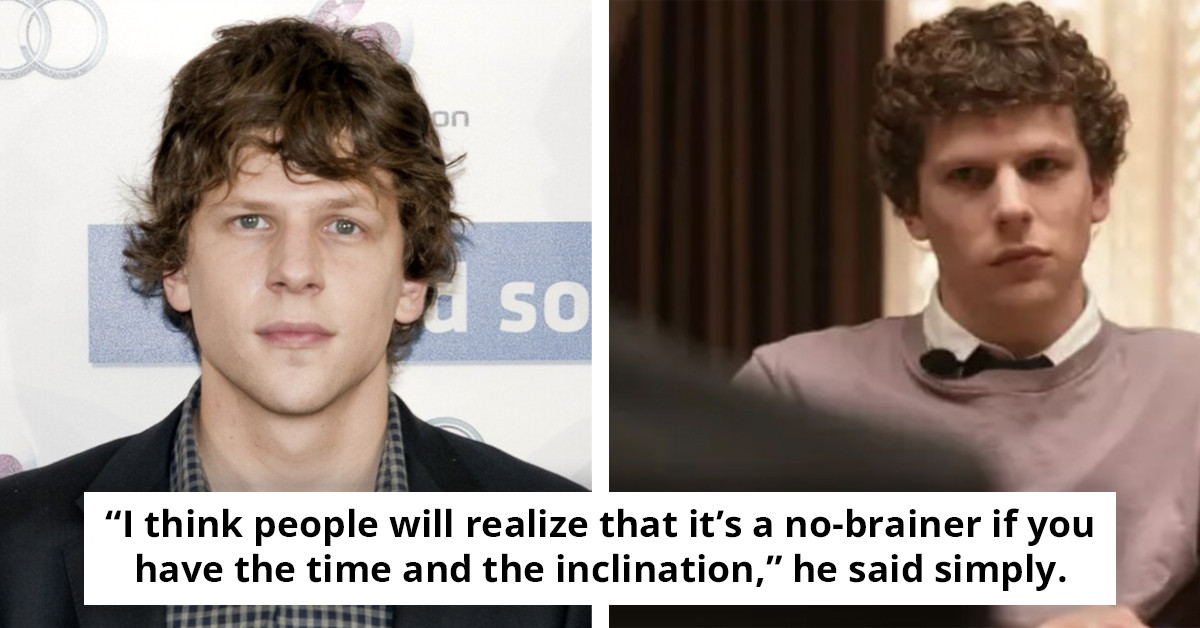
“I think people will realize that it’s a no-brainer if you have the time and the inclination,” he said simply.
 commons.wikimedia
The whole thing gets even more intense when Eisenberg explains the “kidney chain” idea, Kansas City included, because one mismatch can still become a match somewhere else.
And for another shocking celebrity moment, Kim Kardashian’s breakdown after Kanye West claimed her Paris robbery was fake.
And in a world where more than 101,000 people are waiting for an organ in the US, his decision becomes part of a much bigger bottleneck.
It’s not often you hear someone speak so calmly about something that changes a life forever. Yet maybe that’s what makes it so powerful.
Doing good doesn’t always have to come with fanfare or grand emotion; it can be quiet, simple, and deeply genuine. Sometimes the most meaningful acts are the ones carried out without seeking attention, just because they feel right.
Even the emotional fallout matters here, because his off-screen choice is tied to the kind of meaning that can outlast the appointment.
The article underscores the critical need for heightened awareness surrounding organ donation, particularly in local communities.
Organ donation stands as a testament to human courage and selflessness, capable of transforming both lives and communities.
The kidney never lands where he intended, but it can land exactly where it’s desperately needed.
After hearing Justin Timberlake called his condition “relentlessly debilitating,” see his latest health update here: Justin Timberlake’s health update.

Damjan